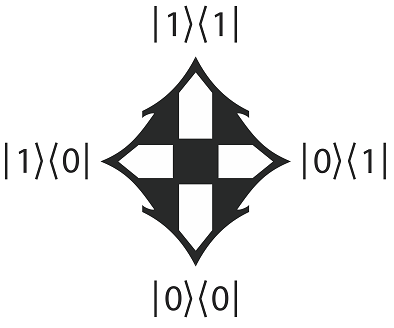

About B-Theory
“No man ever steps in the same river twice, for it’s not the same river and he’s not the same man.” — Heraclitus
The B is for Being and Becoming
Being is a state considered at a moment in time. Becoming is the process by which interaction, observation, and change lead to a new state. The name B-Theory refers to both, and to the difficult transition between them.
Descartes asked how we know that we exist. B-Theory begins with a related question: what mathematical tools might describe the “I” that thinks, and how that description changes? The programme develops formal objects that can be defined, calculated with, tested, and criticized.
From states to observations
Correspondence Matrices and Algebraic Logic represent logical states and operations. ProLTs ask what a family of observations can distinguish. Work on order thinning, concept differentiation, and finite resolution studies what happens when observations change or remain limited.
From observations to models
The longer-term questions concern information, learning, and reflection. A changing system may update an internal representation in response to new observations. B-Theory's proposed directions on Evolutionary Logic, information and boundaries, and self-models identify mathematical questions for this next stage.
The MIND is the connected research programme exploring whether these tools can help formulate sharper questions about concepts and self-awareness. A mathematical representation of distinctions is not, by itself, evidence of subjective experience.
Origin and working method
The programme was started by Brian Theory (Brian Droncheff). Its underlying question dates to 2008, and the B-Theory name was established around 2018. The work has since grown into linked manuscripts, research notes, proofs, computational experiments, and open directions.
AI tools have helped draft and organize parts of the research and check some calculations. Manuscript pages distinguish the scope of present results from proposed connections to the mind. External specialist review and empirical validation remain separate questions.
Research enquiries
For a manuscript reading copy or a question about a specific result, email Brian@B-Theory.com. Please include the project or manuscript title so the request reaches the right part of the programme.