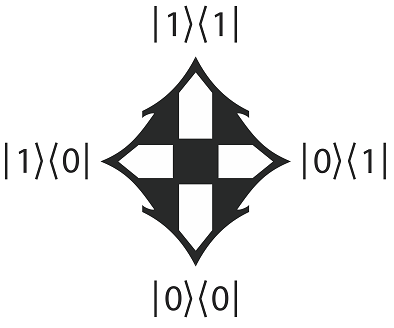

Correspondence Matrices
How can logical operations be represented and combined without losing their meaning across symbolic and numeric forms?
Read manuscript online Or start with the explanation below.
The mathematical tool
Correspondence Matrices (CMs) give numeric Boolean representations of logical operations. The current manuscript develops them alongside formula-valued Logical Matrices (LMs). It specifies how valuation, pairing, changes of frame, and pointwise Boolean operations relate across these two forms.
This gives a way to calculate with logical operators while keeping track of what each representation means. It is part of B-Theory’s Being side: describing a state and the operations available on it.
What the current manuscript establishes
The revised CM/LM paper presents a unified symbolic and numeric representation calculus, including exact compatibility laws. The underlying Boolean algebra and many component constructions are classical. Its contribution is the typed architecture and the precise relationships among its parts.
Why it matters to The MIND
Before asking how a system changes its beliefs or represents itself, we need clear descriptions of states, distinctions, and operations. CMs and LMs supply one mathematical language for that work. Later observation and refinement projects ask different questions about what a system can actually detect.
Current boundary
The paper does not claim that these matrices are physical measurements, demonstrate consciousness, compress truth tables, or provide a computational speedup. Those would require separate models and evidence. See also Algebraic Logic and ProLT observation topologies.
Related manuscript
Correspondence and Logical Matrices: A Typed Boolean Operator CalculusFoundations and synthesis manuscript; current revised version, September 2026.
Site reading copy 1 from September 27 revised manuscript; earlier September 22 and September 27 revisions retained in the collection.
Read online Read the PDF Extracted text (limited equations) See this manuscript's index entry